
To Read, or to Scroll: When an Article Exists and When It Doesn’t Exist
Long reads, short stories and the memory of a Class
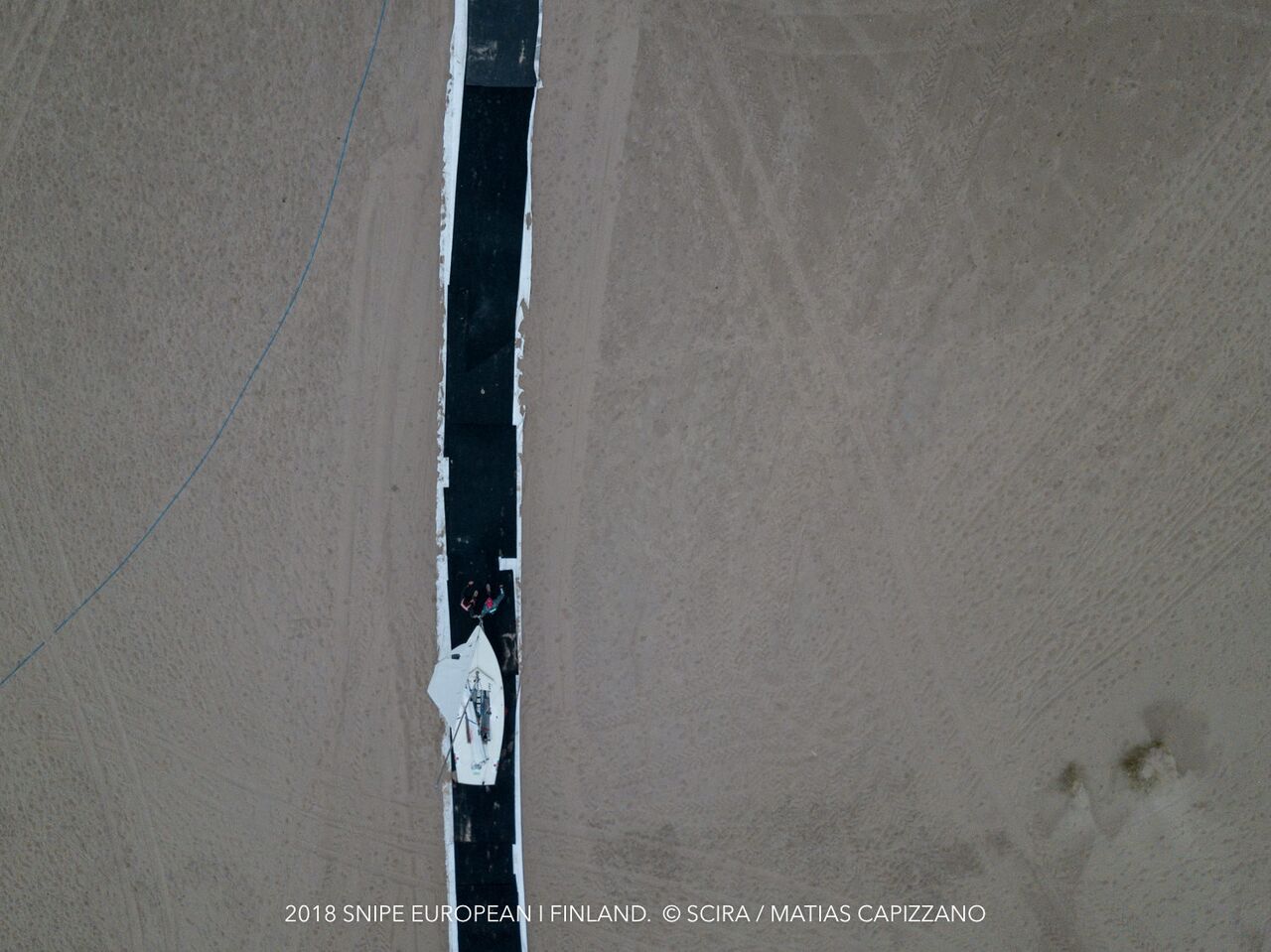
Photo courtesy of Matias Capizzano – A dark line cuts across the sand, like one of Lucio Fontana’s slashes, with one small white boat waiting at its side. Seen from a drone, a regatta becomes abstract art, and perhaps also a portrait of the last reader.
Four years ago, on this very site, I explained with some confidence that a regatta does not exist without photos. I also warned that a post without an image is pointless, since by the third line everyone has moved on to the next one. And I ended by asking: “Dear reader, did you make it all the way to the end of this long article?”
I thought it was a joke. It turns out it was a forecast.
So here is the sequel, with an uncomfortable question. If a regatta without photos does not exist, does an article without readers exist?
The experiment
In September, on the way to Mahon, we published Plotting the Course, eleven episodes on the history of the Snipe Worlds. It meant digging through decades of Snipe Bulletins, old magazines, anecdotes and photographs. I admit I had no idea how long and exhausting it would be.
The website kindly estimates the reading time of Episode 10 at 65 minutes. A Major Championship race has a target time of 60 to 75 minutes. So Episode 10 was exactly one race: no general recalls, no wind shifts, and judging by the results, a fleet scored almost entirely DNF.
At the bottom of that episode, I left a small trap: “Give us a sign if you’re still breathing!”
One reader did. One isolated and, I suspect, rather lonely reader, to whom this article is dedicated. As for the others, I have to draw the obvious conclusion. Either nobody read the story, or the Class has suffered a mass respiratory failure.
Who is this reader?
What has changed: the time available, the habits, or the concentration? Probably all three, and not only in sailing. The surveys point the same way. In the United States, the share of adults reading for pleasure on an average day fell from about 28% to 16% in twenty years. In Italy, according to Istat, the share of people reading at least one book a year for pleasure dropped from 46.8% in 2010 to 39.3% in 2022, the lowest level since 2000. Oddly, we probably read more words than ever. They just reach us in fragments: emails, texts, posts, captions. The August cover story of The Atlantic, “The End of Reading Is Here”, suggests that the age of reading “might be a short anomaly in human history”.
The reader of books and long analysis has become a consumer of stories that last a few seconds. If the story does not grab him, a thumb moves and the next one appears, chosen by an algorithm that knows him perfectly and asks only one thing of him: not to think too long about anything. It selects, and little by little it stupefies.
We are all in it. I have watched myself open the phone to check the wind forecast, hoping to get rich in information useful for the race, and resurface twenty minutes later, having found an unmissable deal on a new alto sax mouthpiece in Massachusetts, one that promises a tone rich in harmonics, and knowing nothing about the wind.
How long is an attention span? Slightly shorter than this sentence, if you are reading it on a phone.
From the coffee table to the feed
Is the columnist being replaced by the social media manager, or even better, by the influencer? Will the history of a Class become a series of reels, two short sentences on a photo?
The Star Class offers a useful example. For its centenary in 2022 it commissioned Carol Newman Cronin, a friend of this site, to write 100 Years of Gold Stars, a beautiful coffee-table book that gathers a century of racing into ten chapters. The Stars have since been clever enough to move with the times, telling that same history in stories on Instagram too, without giving up traditional communication: the book is still there, and the Class still publishes its annual Log. The two can evidently live side by side.
A book has an obvious disadvantage in this respect: it cannot tell you how many people swiped past it. On the other hand, nobody has ever been able to swipe past it. It sits there on the table, heavy and patient, waiting for winter.
Sent from far away
The same thing is happening during the events themselves. Press releases and highlights get thinner and more prefabricated. Too often they are little advertisements for the club that paid for them, written from a great distance by people who know little about sailing. The wind is always “challenging”, the venue always “stunning”, and the fight for the title always goes “down to the wire”, even when it was over on Thursday.
Now compare this with the report from the 1989 Worlds in Karatsu, from the Snipe Bulletin. It begins at 5:30 a.m., with the author on a bicycle at the end of a breakwater, watching the fishermen prepare their boats. He then spends the week on a soaked inflatable, with useless wet binoculars. He tells us about the mayor’s receiving line and the typhoon, and about Connie Commette getting everyone to sign a broken rudder in the parking lot. And after a bad race, he checks his escape route before telling a furious Peter Commette: “Hey Peter, it’s only the Worlds!”
Try fitting that into fifteen seconds with a jingle.
There are still real professionals around, of course, though they are rarer than good starts in a general recall. But is their work appreciated? By whom? And does the club paying the bill notice the difference, as long as the number of views goes up?
Wells’ Wanderings
There was a time when depth came from inside the Class. Ted Wells, the “Wizard of Wichita”, won the Worlds in 1947 and 1949, chaired the rules committee and was Commodore in 1954. He still found time to write “Wells’ Wanderings”, his regular column in the monthly Snipe Bulletin, where technical questions and the life of the Class were examined at leisure. In 1950 he had also published Scientific Sailboat Racing, to help racing sailors, and not only in Snipes, keep up with the technical advances of the day. He needed two issues of the Bulletin to tell the story of the 1953 Worlds in Monaco.
Think about what that meant. The best sailor in the Class was also its columnist, and he assumed his readers wanted to understand why things worked, not just who had won. The format helped: a monthly Bulletin left time to think, room to explain, and a whole month for the reader to get through it.
Nobody ever asked Wells to keep it short. I would have liked to hear his answer.
Is it worth insisting?
Does it still make sense to keep a website? To publish long articles and discussions? Or is it pretentious to think that a text with some content, or even an Instagram story that spares us the usual cheap jingle, can educate anyone, or at least stimulate them? Is this just an elitist complaint from someone who reads to the end of the page and expects applause for it?
Partly, yes. Nobody asked me to spend my September in the Snipe Bulletins. Readers owe me nothing, and silence is not an insult: some of them may have read every word without feeling any need to tell me. The stories also do something useful. They reach people who would never open a website, and I have been recommending them since 2022. It would be a little late to play the victim of a crime in which I was an accomplice.
So let me be clear: this is not an arrow aimed at the reader, nor the lament of an old grumbler convinced that everything was better in the days of wooden boats. It wasn’t. The Bulletin’s report on the 1951 Worlds in Havana came out in January 1952, while today we know the winner before he reaches the dock. I would not give that up. I simply wonder whether we can have the speed without losing the depth.
But there is one thing a story cannot do. It disappears. Plotting the Course could be written only because in 1983, 1989 and 1991 someone took the trouble to write it all down, for a Bulletin that perhaps not everyone read to the last line either. Those pages waited forty years for someone to need them.
What stays
That is the real difference between a post and a website. A post lives on a feed, and the next one buries it. A website is a place with an address, where you can go back and find things. Verba volant, scripta manent, and stories fly too.
This site tries to keep that memory, and it starts from the present. History here does not begin with the Worlds. It begins with the report of the AYC Halloween Regatta or the Copa Otoño, a few lines sent, at least in some cases, by someone in a fleet who took ten minutes after racing to write them. Today that is daily news, of interest to a few friends. In thirty years it will be the only proof that a fleet was alive that autumn, or the first appearance of a name that later ended up on a trophy.
Those small reports sit next to SnipeYesterday, the old Bulletins and the Hall of Fame. Nobody reads all of it, and nobody has to. It is an archive, not a feed: it does not ask for your attention today, it is simply there on the day you need it.
Of course, a website must also look good. I said in 2022 that images come first, and I have not changed my mind. We must attract people, work on a phone and renew ourselves. But a new look cannot be paid for with the past. It happens too often: a site gets a brilliant redesign, and years of reports and photographs vanish behind an error page. The job is threefold: be attractive, keep the old contents and produce new ones.
We tend to imagine the loss of an archive as a great catastrophe. That same essay in The Atlantic opens with the most famous one: the Library of Alexandria, where Eratosthenes calculated the Earth’s circumference and Zenodotus edited Homer. Tradition blames war, from the fire started by Julius Caesar to the sack of the fourth century. But contemporary historians, we read, prefer “a more mundane cause of death: negligence.”
That is how archives die. Not in a fire, but on the day nobody renews the domain.
A parenthesis on a word
Contents, I said. The word deserves a moment, because it has quietly changed meaning. It comes from the Latin continere, to hold together, and today it leads two lives. One is the substance of what is said, as when we complain that someone talks a lot but his words lack content. The other is whatever is offered on social media: words, images, music, anything that will do.
In the first sense, content comes first: someone has something to say, and then looks for the form. In the second, the form comes first: there is a vertical frame, fifteen seconds, a weekly calendar, and something must be found to fill it. It is the difference between having something in the jar and having a jar to fill. A “content creator” would have puzzled Ted Wells, who merely thought he was writing about boats.
The line does not run neatly between the website and the phone, though. A reel can hold more substance than a page, and I have certainly published articles that talk a lot. The question is not the length, but whether anything is left once it is over.
Holding the course
So perhaps how many readers an article has today is the wrong measure. Stories are for the people who are here now. Articles are for the ones who will come looking. They do not need a champion of history, and I am not applying for the job: this archive belongs to everyone who has sent a report, taken a photograph or edited a Bulletin. They will only need a link that still works.
I think we will keep going. Not because the numbers ask us to, but for the same reason we go out on a day with no wind and wait for a race: because that is what we came to do.
Dear reader, are you alive? Or are you dead this time too?
If nobody answers, I will take comfort in Plato. In the Phaedrus, Socrates tells of an Egyptian king warning a god that his latest invention “will produce forgetfulness in the minds of those who learn to use it”. The invention was writing. So the first alarm about a new medium ruining our minds was raised against the very thing I have just spent all these words defending, and we know about it only because Plato wrote it down.
Note: The “Exchange of Views and Reading” section of this website hosts the views of the Snipe Sailors.
This article represents a personal opinion, which may not coincide with the official opinion or view of the Class or other sailors. We deem it useful to discuss (naturally avoiding offensive content) various topics relating to our Class, to allow for an open and democratic discussion, as has always been the case on SnipeToday for more than a decade.
Dear readers, if you want to reply to this article, agreeing, or disagreeing, or proposing different solutions, I will be happy to host you in this section of the site (email to: [email protected])
Leave a reply
Your email address will not be published. Your comment will be revised by the site if needed.





2 comments
Sylvie Le Bour
I do agree with you. Archives are important and yesterday's archives are created today. We must keep writing reports and filing photos otherwise the mere existence of the Snipe will be replaced by a great void. Thank you for your hard work on behalf of the Class!
Leave a reply
Your email address will not be published. Your comment will be revised by the site if needed.
Francesco Rossi
I am still alive 😂
Leave a reply
Your email address will not be published. Your comment will be revised by the site if needed.